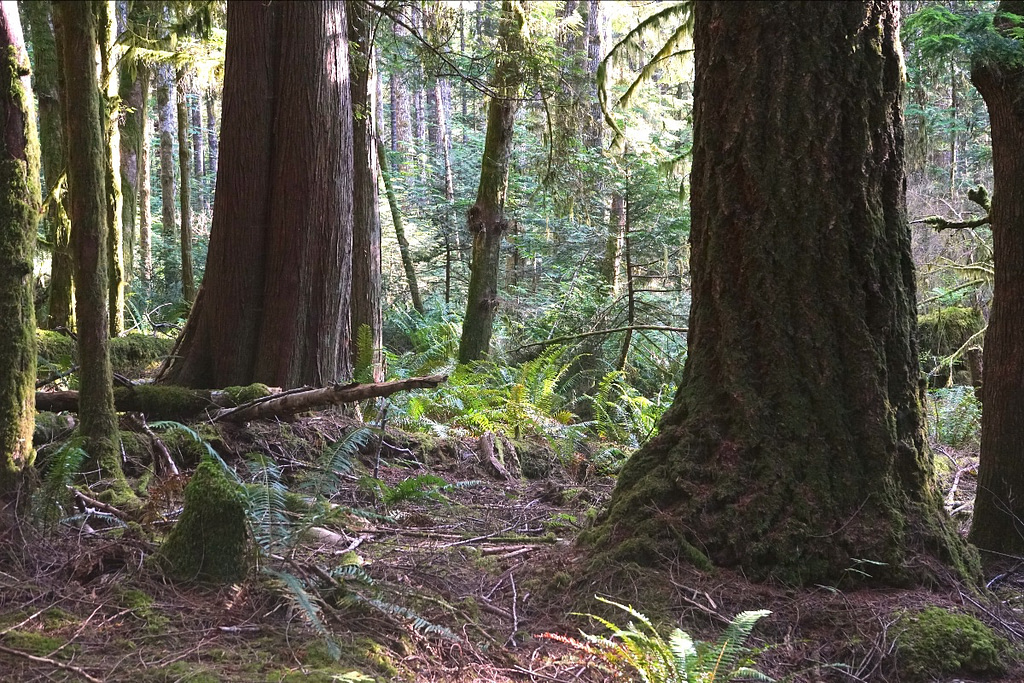
Mature redcedar and Douglas-fir in the Sunshine Coast Community Forests proposed cutblock AN14, Gray Creek area
The Sunshine Coast Community Forest (SCCF) has tenure on the lower Sunshine Coast in three distinct areas – Halfmoon Bay, Angus/Gray/Burnett Watersheds and the Wilson Creek Watershed. They currently have developed their five-year logging plan for these areas and the window for comment will be closing Jan. 31, 2023. Though the plan is shared with the local shíshálh Nation, SCCF is not legally obliged to engage with the Sunshine Coast Regional District or the general public in the final plan and have not encouraged such. There is some flexibility to comment on blocks until spring as new information arises, and the schedules for logging may change influenced by market conditions. SCCF has the plan available at their website, however has not conducted any public meetings specifically to review the plan and invite feedback.
A map showing the cutblocks that SCCF is planning can be found here:
ELF’s comments on SCCF’s planned cutblocks can be found here:
The logging that has occurred during SCCF’s history, has largely targeted mature forests (120–160 year range) since there’s no old growth left after decades of industrial logging by larger corporations within their tenure area. It’s resulted in a dire lack of biodiversity in the impacted forest ecosystems. What biodiversity is left is found in the mature forests stands that are commercially viable. The hundreds of tree farms left behind by past clearcutting are not of sufficient volume and size to make them commercially attractive to SCCF.
“When we look at this five-year plan we see important mature forest stands that could be lost, such as in the Angus Creek area where the proposed Blk AN14 cutblock has old-growth Douglas-fir with an emerging cohort of Western redcedar and Western hemlock. We followed a game trail that led to a year-round freshwater spring. In our opinion, this is one of the blocks that needs to be removed,” states Ross Muirhead of ELF.
“Without a detailed explanation of each proposed block by SCCF Planners, it makes it very difficult for the public to understand, let alone comment on each block from the map provided. In our opinion, SCCF could have done more upfront to engage the public as this January 31st deadline fast approaches,” adds Hans Penner, also with ELF. Another block we’ve identified that needs to be removed from this plan is EW19, which butts up against the northernmost Mt. Elphinstone Provincial Park parcel #3. This area has many old-growth Douglas-fir, wildlife trees plus an active black bear den, and is located in the East Wilson Watershed providing good connectivity east to park parcel #2. Additionally, the Wilson Creek Watershed is already heavily hydrologically damaged from excessive logging that has led to downslope flooding and scouring of creek banks with heavy rains, lower than normal flows during dry periods, and degradation of salmon habitat. The Wilson Creek Watershed needs to be allowed to recover.
Clarification on ELF’s Relationship with SCCF
We have accepted an invitation by SCCF to meet with them once a month on an ongoing basis to discuss operational issues, however, we will maintain our independence and provide constructive criticism as we have quite a few concerns that need to be addressed. It is not a “collaboration,” the word SCCF has used in their public communications and echoed by the media, which is a mischaracterization, it is simply a dialogue though one we hope brings long overdue changes to their operations. They have not asked us to collaborate and currently have no structure that allows for such that we know of.
For more information contact:
Ross Muirhead
Forest Campaigner
672-999-9477

