At November 27 – Protect the Baby Beaver Forest
Dear Mr. Rockall,
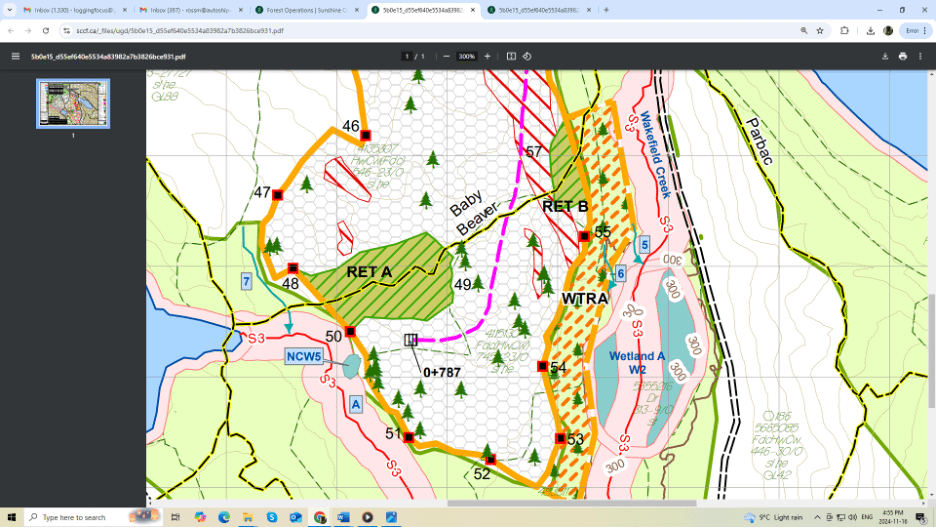
We would like to bring to your attention that SCCF’s proposed Blk HM64 in the Wakefield Creek Watershed would impact forest connectivity between Beaver Pond to the east and Crowston Lake to the west. The main trail that connects these two aquatic bodies is Baby Beaver Trail, hence the name given to this forest.
Within this relatively small area, we find these two water bodies, the beginnings of Wakefield Creek (outflows from Crowston Lake and Beaver Pond), a sensitive wetland network, an older stand of trees and an at-risk blue-listed ecosystem of western redcedar-sword fern.
Proper planning has not been completed by SCCF for the Wakefield Creek Watershed as illustrated by the lack of a Watershed Assessment, and lack of full disclosure to the public of HM64’s forest conditions on SCCF’s Block List. read more
At October 7 – SCCF’s Blk AN12A logging conflicts with Recreational
Reserve 3136
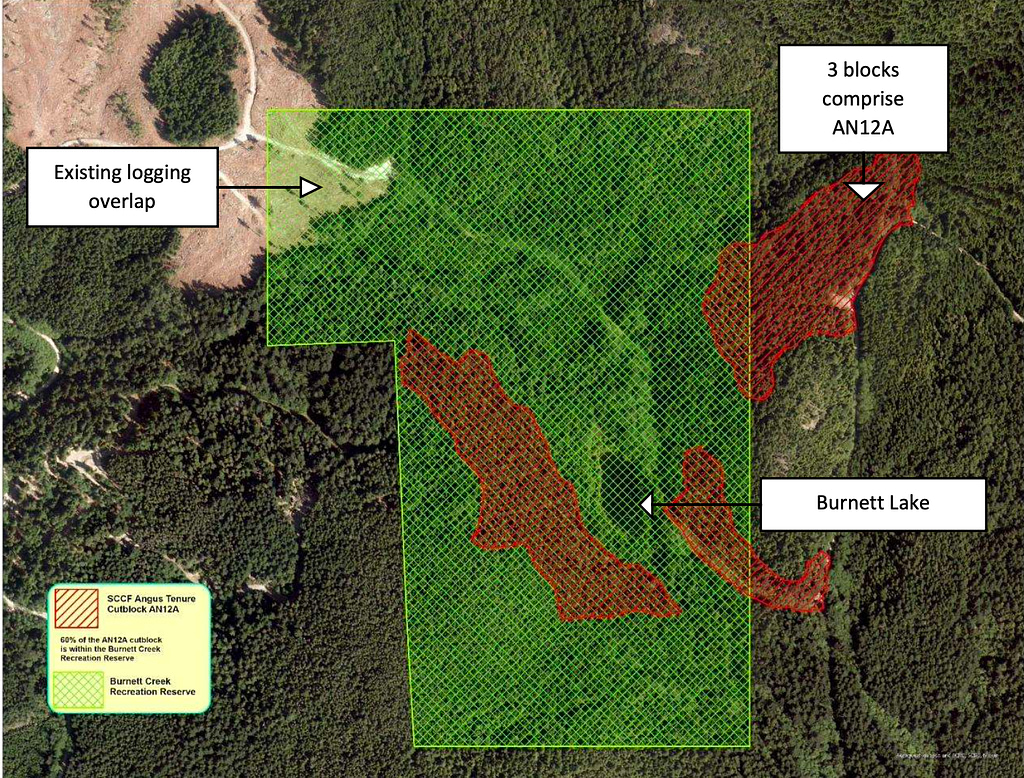
ELF conducted a field visit into the Burnett Creek Watershed to examine three cutblocks that make up Sunshine Coast Community Forest’s (SCCF) planned Blk AN12A, and concluded that it should be removed and protected as a Recreational Site when it was noted that the block overlaps with REC3136. The BC Data Catalogue confirms a Burnett Lake Recreational Reserve in the Burnett Creek Watershed and specifies this as its designated land use. read more
At August 11 – Open Letter Regarding Flooding Events
Please review this short report highlighting flooding issues in several creeks on the lower Sunshine Coast where BC Timber Sales (BCTS) logging within the watersheds prior to the November 2021 atmospheric river event, resulted in catastrophic downstream infrastructure failures. To date, the public has not seen a review of what caused these failures. Through this report, we seek answers from your combined agencies.
None of the creeks listed below have water impoundment in the form of lakes or ponds which helps to regulate flow. They are considered “super-sensitive” as their flow is completely dependent on ground water recharge. It’s well-known in the scientific literature that it’s the forest condition itself that regulates groundwater recharge by evapotranspiration, fog drip, melt drip, percolation, etc. Therefore, changes in the forest cover of these types of watersheds impacts flow even with small changes to the existing forest cover. read more
At August 1 – Contract between BCTS and Polar GeoScience (No Baselines)
This letter brings forward previous issues highlighted by our organisation and not responded to yet by the BCTS office regarding a July 23, 2020 Consulting and General Services Contract between read more
At July 30 – South Elphinstone Watershed Creeks Drying Up
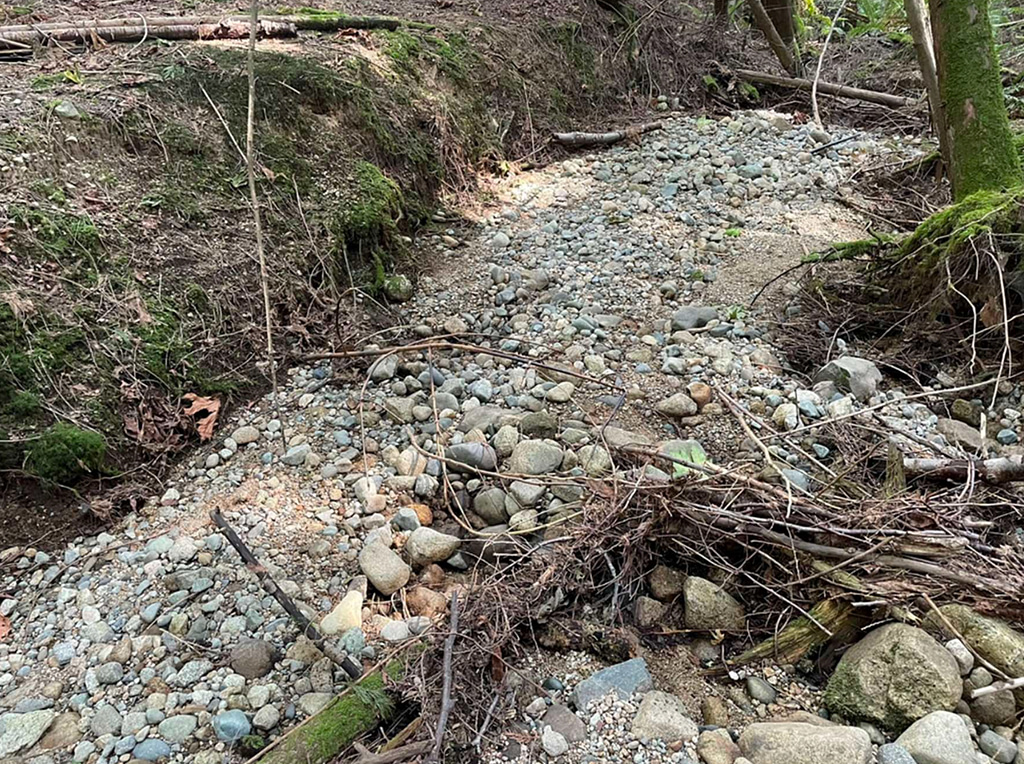
This report provides field evidence from July 14, 2024 of extreme low flows (aka no flows) in creeks where BCTS’ Blk TA0521 has been planned. Impacts from incremental increases of logging and roadbuilding in these creek’s watersheds cannot be fully understood because BCTS’ consultant Polar GeoScience, who produced the Mt. Elphinstone South Watershed Assessment, failed to provide seasonal discharge flows for each of the creeks. Therefore, there are no flow baselines for predicted analysis. read more
At July 20 – Feedback on SCCF’s 5-year Operating Plan (2024 Referral)
 This report is our organization’s feedback to the SCCF’s operating plan covering the next 5 years. The public has been given 45 days to comment on a complex plan with only supporting maps and a block table as reference material. In the blocks we’re opposed to, ELF went out and found the blocks in the field, traversed them, made notes, gathered photographic material, in some cases invited a registered biologist to look at habitat features and extended an invitation to a shishalh knowledge-keeper seeking his input on First Nations values. We do not know how other members of the public or groups can provide reasonable feedback when no opportunity has been extended by SCCF to actually walk the blocks in advance of development, i.e.: logging and roadbuilding. In addition, 45 days to comment on a complex, information rich plan without more transparent engagement is a process set up to be heavily compromised. It will be interesting to see how many comments SCCF receives. read more
At April 8 – BCTS’ TA0521 planning is full of holes

Within this context of one provincial agency urging all regional agencies to prepare for another drought cycle and the best mitigation measure is to “protect watersheds,” while another arm of the government, BC Timber Sales, is proposing to log Blk TA0521 affecting 4 small watersheds (Molyneaux, Slater, Leek and Whitaker) that supply groundwater recharge to wells for Sunshine Coast residents living above Highway 101 within these catchments – indicates something is out of sync. read more
At March 28 – The Elphinstone Water Protection Forest: the beauty and power of the forest

This document reviews forest conservation issues with the proposed BC Timber Sales (BCTS) Block TA0521 and provides a link to a YouTube video that takes the viewer inside the forest in question. BCTS would like to put the block up for auction April 1st, however many unanswered questions persist, including why they’re not following the mapping provided by the provincial government’s Old Growth Technical Advisory Panel – TAP (Daust, Holt, Price) that through their Map 7 Recruitment Forest, identifies much of TA0521 and surrounding similar forests as “recruitment forest” meant to become “tomorrow’s old-growth.” Conservation of recruitment forest is critical in the Chapman Landscape Unit (LU) as it’s well below the TAP’s 10% old- growth threshold. LU’s are management areas where baseline data is recorded by provincial ministries. An LU that has less than 10% old-growth remaining is threatened with irreversible biodiversity loss. read more
At February 26 – SCCF Plans Clearcutting in the Wakefield Creek Watershed

The Sunshine Coast Community Forest (SCCF) – a logging company owned by The District of Sechelt, appears to be poised to begin logging in the Wakefield Creek Watershed sometime in 2024. The block is ‘engineered’ with Falling Boundary, Road Centre Line tape and Falling Corners in place. Block HM64 location is within the drainage area of Wakefield Creek, which means all surface runoff from within the block reaches this creek.
A watershed is defined by the height of land on both sides of a river or creek. Wakefield Creek has a source and is fed by ground water recharge. The source for Wakefield Creek is Crowston Lake and the surrounding intact forest in this watershed provides stable ground water recharge. read more
At February 26 – Poor Planning at SCCF’s Blk AN12A – Burnett Creek Watershed

ELF conducted a field visit to this forest and conclude that the 3 blocks that make up AN12A should be removed from Sunshine Coast Community Forest (SCCF) log plan and immediately become ‘Reserves’ for several key reasons, including: numerous ‘old forest’ conditions, habitat for blue-listed elk, high recreational values, connectivity to the Burnett Creek corridor, contribution to watershed processes, a wet zone providing flow to nearby Burnett Creek, old- growth recruitment opportunities in a depleted CWHdm in both the Chapman Landscape Unit and SCCF tenure. The block could be logged in 2026. read more
At January 18 – Protect our Infrastructure – No Logging in the Headwaters

The S. Elphinstone Watershed Assessment delivered to BC Timber Sales by the consulting firm, Polar GeoScience, identifies downstream infrastructure (points of interest), including culverts, roads, electrical & gas lines, wells, and water diversion, and provides levels of risk to each based on changes to the forest cover by BC Timber Sales logging at Blk TA0521 on the S. Elphinstone Slopes, Sunshine Coast, B.C.
A major concern is that residents above Highway 101 are not connected to the Sunshine Coast Regional District (SCRD) water supply system, instead rely on their own resources in having functional wells in place, or water diversion systems which are dependent on consistent ground water flows. There are 94 registered wells in the study area. Its common knowledge that logging & roadbuilding impacts water absorption and water delivery timing to the ground. To what degree is not completely understood, therefore since human health is a higher value than timber extraction, the pre-cautionary principle says do not change conditions that can have a negative effect and influence groundwater flows. read more
At January 15 – Unbridled logging plans in the lower Fraser, Chilliwack and Nicolum Watersheds increase climate risks
This review highlights plans by BC Timber Sales’ (BCTS), a government agency of the Ministry of Forests, to sell off an alarming number of timber across 81 cutblocks of Crown and First Nations lands to private contractors with no public engagement planned. The BCTS-Chinook Division (head office Chilliwack) has these 81 cutblocks planned or active beginning 2023 extending out to 2026.
These combined blocks represent a staggering amount of forest cover loss at 1,568 ha resulting in untold post-logging effects, including terrain stability issues, peak flows to nearby water channels, erosion of channels, rain-on-snow events, sediment transport affecting salmon habitat, risks to downstream public and private infrastructure, plus habitat loss and impacts on mature forest recruitment. read more
At January 4 – Riparian Issue at SCCF’s AN03

ELF conducted a site visit to the above Sunshine Coast Community Forest (SCCF) block on Jan. 3rd and documented a pending problem where logging is planned to the top edge of a gully. The stream uses the gully as its channel and the current riparian set-up is questioned. read mor