Beginnings of Elphinstone Logging Focus (ELF)
Mount Elphinstone rises up above the communities of Gibsons and xwesam (Roberts Creek), B.C. on the unceded lands of Sḵwx̱wú7mesh (Squamish) Nation with its western ridge facing the shishalh (Sechelt) Nation. The peak offers a commanding view of Howe Sound to the east and up the Sunshine Coast to the west.
Elphinstone Logging Focus founder Ross Muirhead lives in xwesam on shíshálh Nation lands, where the first of many local logging protests against BC Timber Sales (BCTS) and Sunshine Coast Community Forest logging company began. In 2010, long-time Roberts Creek resident Gerry Hills on Crowe Rd. drew Ross’s attention to a troubling situation. She had been trying, on her own, to stop BCTS’s logging of an intact forest above her property – one of the first land communes on the Coast. This was BCTS cutblock A71827, forced upon the community with no meaningful public engagement. Her residence, as with all properties above Highway 101, are off-line from the Sunshine Coast Regional District’s water distribution. Therefore, they depend on the continual supply of water from undisturbed, clean-flowing creeks for their domestic water supply. The cutblock included logging across streams and creeks that made up the water supply for downstream residents.
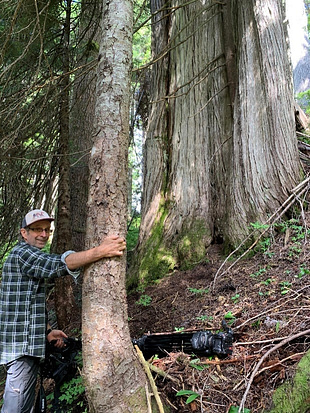
After meeting with Hills, Muirhead quickly mounted a formal campaign, registered the group as Elphinstone Logging Focus (ELF), and had mail-in cards printed, directed to the BCTS Manager, asking him to cancel the logging. ELF put in a trail that traversed the forest and lobbied the BCTS officials to plan a meeting with Hills in the block to hear her concerns first-hand. The logging contractor (Procknow) also showed up. This is when ELF became a forestry watchdog group with its mandate to track proposed cutblocks to determine “post-logging effects” on the landscape. To date, ELF has look at over 40 logging proposals just in their region (Sechelt, Chapman, Howe Landscape Units), submitting comments on each.
Unfortunately, in 2010 the clearcut logging went ahead, knocking down the naturally evolved forest, which Hills and ELF were to protect, back to ground zero. The only good news was that BCTS agreed to upgrade the creek crossings with clear-span bridges instead of culverts which can narrow the channel, increasing flow velocity resulting in stream bank erosion. Two span bridges were helicoptered in place, then removed. ELF reasoned that we could make a difference using carefully argued positions and establishing respectful relationships with BCTS and its contractors.
Soon afterwards, Hans Penner, who had long-standing concerns about logging impacts in the regional community drinking watersheds, contacted Muirhead. They both combined their respective interest in forest ecology and conservation. Penner brought valuable engineering and planning experience to the organization to complement Muirhead’s campaigning background. The two of them have been a force since 2011, responsible for several logging deferrals and the outright cancellations of several cutblocks, leading to wider environmental protection on the Lower Sunshine Coast.
For a small group working in a rural region, ELF has steadily grown to 900 supporters. This dedicated non-profit has worked with leading scientists (Baden, Banner, Brett and McCrory, Alila), funding their scientific reports. This has tipped the favour towards wider forest conservation on the beautiful yet ecologically challenged Sunshine Coast.
Origins of the name Elphinstone Logging Focus (ELF)
The Elphinstone reference draws its name from both the local prominent peak and a legend. The name Elphinstone appears in an old story that pits those with privileged power against marginalized others. The copy below is from an Internet search for the name “Elphinstone” (ELF has added the interpretive content in square brackets to link its position as a forest protector in relation to the timber industry, creating a symbolic metaphor):
“A common myth is one about a witch called Meg and the naming of the village where she lived. Meg [government-controlled forest industry] had servants who were Elfs [forest users] and she was cruel to them [no government accountability]. One day, she went to the area between, soon to be named Elphinstone and Orminston, and ate in her carriage, telling her servants not to disturb her.
“One Elf broke into her carriage once she had fell [sic] asleep and stole some of her leftovers [an attempt to secure forest protection]. Meg, however, awoke and caught him. She took him back to Elphinstone and trapped him in her stone or “Meg’s chuck” [removing the public from the decision-making process]. Hence the name Elph (elf) in stone.”
As ELF, we are essentially forest users who respect the inherent wisdom of old forests and defend against the unbridled exploitation of them.
For information on the two First Nations, on whose land we work and play, visit their respective websites: