
Every year across Canada and B.C., human and natural disturbances destroy millions of birds’ nests and their habitat. Clearcut logging across both boreal and temperate rainforests has devastated bird populations for decades, resulting in some forests becoming eerily quiet. The science states:
“The forests of Canada support some of the highest densities of breeding birds in North America. In aggregate, Canada’s forests produce a large proportion of the continent’s avifauna (Blancher 2011). The southern portion of Canada’s forests in particular are undergoing intense resource development resulting in conservation concerns about potential impacts of industrial operations on birds breeding there (Wells 2011).
“A dominant source of anthropogenic disturbance in Canada’s forests is harvesting for pulp, paper, and timber production. How birds respond to forestry activities has generally focused on numerical and demographic changes caused by the effects that forestry has on the composition, structure and spatial pattern of forests (Villard 2012) at varying times since harvest (Song 2006). These legacy effects are an important conservation issue for many bird species (Cumming et al. 2010)”…“More recently, the direct loss of birds from the harvesting process has become an additional area of concern.
“The basic premise for this investigation is that harvesting practices during the breeding season destroy nests incidentally as part of the practice of removing trees, largely, but not exclusively, by clear-cutting and ancillary activities such as hauling, site preparation, and other on-site operations. Legal challenges under the Migratory Bird Convention Act (hereafter MBCA) of this loss have become a controversial issue between the forestry industry and conservation groups but little effort has gone into quantifying the actual risk of loss of migratory bird nests by forest harvesting in Canada during the breeding season. In particular, the implications nest loss has for avian population demography in any given year is not well understood and is important for assessing short- versus long-term risks of forest harvesting on bird populations.” [reference]

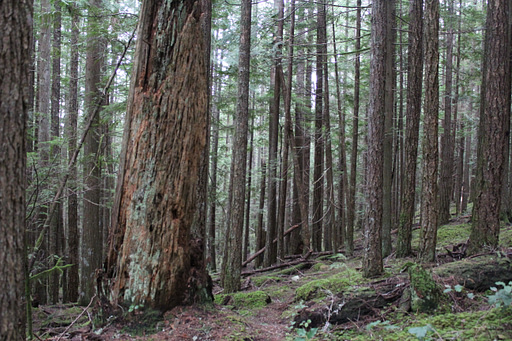
The SongBird Forest above the community of xwesam (Roberts Creek) on unceded shíshálh swiya (lands) is under threat from clearcut logging by the Sunshine Coast Community Forest (SCCF), a logging company owned by the District of Sechelt. Step into this forest on the right day (early morning and evening are best) and you’ll be welcomed by the sweet chorus of birds singing for their own delight or for inter-species communication. Winter Wrens, Sparrows, Juncos, Flickers, Red-headed Woodpeckers, and Ravens can be heard throughout the shrub and forest canopy. Follow the trail to the rocky bluffs and you may see Eagles soaring above on the updraft provided by these warmer zones.
The Sunshine Coast needs one forest protected to honour our avian friends. This forest is also a critical zone to add to the small existing Mt. Elphinstone Provincial Park. There has been a 20-year initiative to expand the park from 140 hectares (divided into three separate “biological islands”) to a robust 2,000 hectares. The SCCF logging company has tenure in this East Wilson Watershed, granted to them by the B.C. Minister of Forests. In 2021, the SCCF drew up logging blocks EW18B, EW 18A and EW19, even though they’re well aware of the social objectives to expand the park to include these forests. Our Sunshine Coast Regional District (SCRD) supports the expansion of this park under Bylaw 641, which reflects the Roberts Creek Community Association’s Official Community Plan aspirations for an expanded protected area to enhance the values that these wonderful mature forests provide. This includes traditional First Nation use, recreation, biodiversity, carbon-sequestering, spiritual enhancement, etc.)
More pictures of the SongBird Forest can be found at ELF’s Facebook page.
Directions: Turn off Highway 101 (in Roberts Creek) onto Roberts Creek Rd. heading north.
Drive straight up the hill until you reach a Forest Service Road (FSR) and carry on.
At the top of this dirt road it turns left. In 2 mins. you’ll pass over the East Wilson Creek bridge. Note a private property on the right, followed by an S-curve in the road, then an opening on the right to an old road – do not take that.
As the road begins to climb, slow down, keeping an eye out on your right for flagging and our SongBird Forest sign tucked off the road.
Park on the left. The trail is steep as it climbs to the highest point to a mossy rock bluff. Ranked 7 – 10 for difficulty. Hiking time is 1.5 hrs. Look for signs at intersection points. If you feel that you’re lost then backtrack out.


