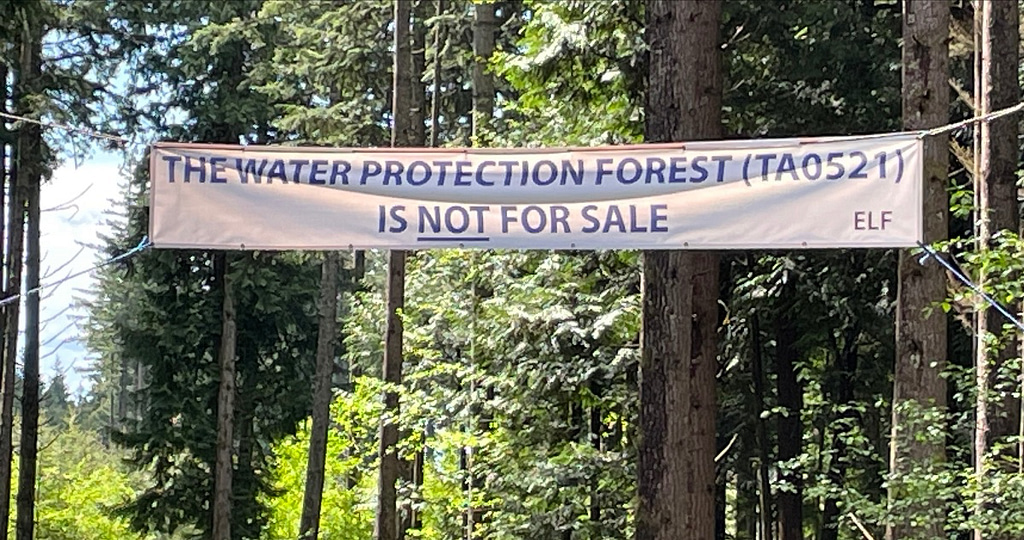
For the last two years Elphinstone Logging Focus been fighting to protect a regionally rare area of mature, native forest on the southern slope of Sunshine Coast’s Mt. Elphinstone above the community of Roberts Creek that we call the Water Protection Forest. We’ve used science, lobbying, a letter and postcard campaign, and have blockaded the road to the proposed cutblocks for months, all to no avail. The bidding period for these cutblocks totaling 17ha, closed June 4 with BCTS awarding the contract to Oceanview Forest Products, despite ELF, the Sunshine Coast Reginal District, community members and a leading hydrologist in BC, UBC’s Dr. Younes Alila in the Dept. of Forestry, bringing forth valid concerns and objections. BCTS continues to ignore the public and both the biological and hydrological science that should have protected these blocks, and by extension protected our community.
The Water Protection Forest, what the BCTS and media has been calling the Joe Smith cutblocks or TA0521, is an important area as much of it is designated old-growth recruitment forest, mapped by the province’s own commissioned Old Growth Technical Advisory Panel (TAP) since the landscape unit it’s located in has less than the minimum 10% old-growth requirement needed to prevent permanent near-term loss of biodiversity. ELF’s GIS analysis shows this to be a Coastal Western Hemlock dry maritime ecosystem with approximately only 2% remaining as old forest in the Chapman Landscape Unit. BCTS disingenuously calls it a second growth forest to diminish its value in the public eye, but it’s actually primary fire-recovered native forest, never before clear-cut logged, only having had some limited historic hand logging of the odd cedar for shakes. It contains many mature trees and old growth conditions including a complex understory of bushes, plants and fungi. But though the province has said it would be adopting TAP’s 14 recommendations four years ago that would salvage this area, they’ve still not and critical remnant forests continue to fall. Even BC Timber Sales acknowledges it contains red (endangered) and blue listed (of special concern) plant communities, but because unlike most provinces, BC does not have endangered species legislation, it can still be destroyed. The Sunshine Coast is losing its ability to recover from the almost total loss of complex old growth ecosystems of some predominate forest types, as even mature recruitment forests like this, the potential old growth of the future, is still being logged.
Another issue we are greatly concerned about is the hydrological integrity this forest provides to our community. It helps in maintaining and regulating creek flows in numerous watersheds (Joe Smith, Molyneux, Slater, Leek, Higgs Brook, Cornwallis Creeks), and groundwater to downslope wells during these uncertain times of escalating droughts, floods and weather anomalies.
The consultant Polar Geoscience, who authored the watershed assessment for these blocks advised BCTS to ensure that Ministry of Transportation (MOTI) complete a “stream crossing review” before any logging or roadbuilding takes place due to concerns that downstream road infrastructure, such as old and undersized culverts, have the extra flow capacity to handle increased runoff originating in TA0521, but MOTI stated that they don’t have the budget to complete a stand-alone stream crossing
review. We had 6 road washouts at creek crossings as well as many floods on the lower Sunshine Coast during the last atmospheric river of 2021, all influenced by logging in headwaters of creeks, and we can expect more of such in the future. It is the public through our tax dollars, that foots the bill for damages to infrastructure that logging contributes to.
We retained UBC’s Dr. Younes Alila to review and critique BCTS’s commissioned hydrological review which as expected, used the outdated “science of convenience” to greenlight continued logging, though they have now inexplicably reduced the cutting area by half. We and Dr. Alila, believe that their consultant Polar Geoscience, scaled back their original recommendations for logging a much larger area over concerns that they could be personally liable if the logging creates downstream hazards such as flooding, a mud or debris flow, or damages to homes or infrastructure, but they still greatly underestimate loggings impacts and the hydrological recovery period needed in coastal watersheds, all of which are still suffering from past industry abuse here. BCTS plans to leave 500 trees standing, but it is in reality just modified clearcutting that will further deplete biodiversity and open up the forest canopy such that it no longer functions to protect the hydrological integrity of the impacted watersheds.
Dr. Alila has just produced a second rebuttal to BCTS’s flawed hydrological review. You can read just his two-page executive summary and conclusion, or the entire report HERE.
One of his central arguments against BCTS’s flawed hydrological review is that they did not assess the entirety of the watersheds that would be impacted, but instead looked at them at the stand or cutblock level, which discounts cumulative impacts on the totality of a watershed from past logging and development.
He criticized their use of outdated and rigid “deterministic” hydrological modeling using tree heights, also known as Equivalent Clearcut Area, instead of a “probabilistic” model which is a wholistic approach considering a multitude of factors including chanciness and the unpredictable climate anomalies we increasingly face.
Dr. Alila also condemned the BCTS report for discounting “rain on snow” events that lead to increased flood and drought risks, something that doesn’t occur where the tree canopy is intact. Snow in a clearcut is directly exposed to sun and rain and can melt and run off all at once, exacerbating both high and low flows in a watershed, increasing a community’s risks and decreasing our resilience in the face of growing climatic threats. He states that “a modest increase in magnitude from logging can result in dramatic increases in frequency of peak flows,” meaning a little logging can lead to disproportionately more frequent flooding.
Additionally, Dr. Alila denounced the BCTS reports dismissal of the importance of “meltwater drip,” the process whereby trees intercept wet snow which then slowly melts, drips down and is absorbed by the ground below, recharging the groundwater, another mechanism that if disrupted, has serious implications on both flooding and droughts.
Accordingly, Dr. Alia has called for the outright cancelation of Block TA0521 as have we. Thus far, he and ELF have been ignored. We are considering filing a complaint with the provincial forestry watchdog, the Forest Practices Board for BCTS’ reckless negligence in awarding a contract on the block. It’s difficult to stop logging from proceeding once a contract is in place.
In 2022 Sunshine Coast, was the first municipality in Canada to declare a state of emergency over drought and there’s a large body of evidence that logging is contributing to it. There are dozens of water licences on creeks that could be impacted by upstream logging of Blk TA0521and many more nonregistered wells that depend on groundwater recharge within the same watersheds, yet the science BCTS chooses to depend on, discounts most of the hydrological mechanisms that maintain well-functioning watersheds.
The logging of BCTS’ Timber Sales Blk TA0521, has never been supported by downslope residents, the wider community, or the Sunshine Coast Regional District. The Squamish Nation signed off on it in 2018 before old- growth recruitment mapping had been done or the mounting evidence of industry’s and government’s flawed hydrological science was more widely recognized. The public process is broken, and our forests and community are once again paying the ultimate price with increased risk of floods, droughts, and damages to infrastructure, loss of biodiversity, degraded
aquatic habitat, and decreased community water security. Our own life support systems are still being undermined by an agency that ignores current science and prioritizes logging above all other needs and values.
Please watch this ELF VIDEO providing a comprehensive overview of the Water Protection Forest, including a walk-through showing the interior conditions of this old forest.
Contact Ross Muirhead, lead forest campaigner for more info at loggingfocus@gmail.com or at 672 999-9477
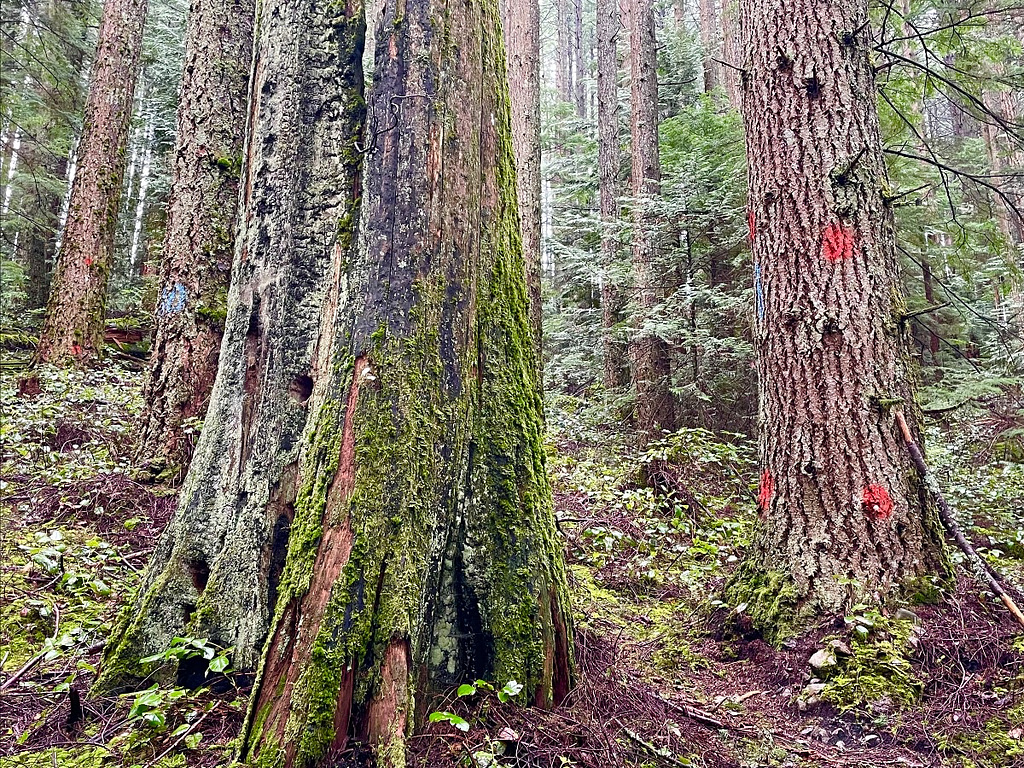
This forest contains endangered plant communities and many old growth characteristics such as mixed ages and species of mature trees, dead standing trees, ferns, mosses, and shrubs in the understory, and a wide variety of fungi. The tree with red dots is a “leave tree” in what would essentially be a slightly modified clearcut. Many such trees blow down once the surrounding forest is gone.

